

When your business needs financing, the first option many owners consider is a traditional bank loan. Term loans or other forms of bank financing may be available to you, but they aren’t always the right fit, particularly for fast-growing or seasonal businesses.
Invoice factoring offers an alternative approach. Instead of borrowing money, you leverage your unpaid invoices to access immediate cash. Let’s look at some of the key differences between invoice factoring vs. bank loans.
How Invoice Factoring Works
Invoice factoring is an alternative type of financing that can help businesses boost their cash flow. As one of several alternative financing options, it turns your accounts receivable into immediate cash. Here’s the typical process:
- Submit invoices to a factoring company.
- The company advances a percentage of the invoice value (70–90%) upfront.
- Your customers pay the factoring company directly, per the invoice terms.
- Once payment is received, the factoring company remits the balance, minus a small fee.
Factoring is primarily evaluated based on your clients’ creditworthiness, not your business history. It’s accessible to startups, seasonal businesses, and companies with limited collateral.
Many industries use invoice factoring, including transportation, hospitality, IT, energy, temporary staffing, and business services.
How Bank Loans Work
Bank loans, also called term loans or traditional financing, involve borrowing a fixed amount of money to be repaid over time with interest. The key steps include:
- Application and underwriting, which often require financial statements, forecasts, and collateral.
- Approval based on strict criteria, including debt service coverage ratios, business history, and existing leverage.
- Funding disbursement in a lump sum or scheduled installments.
- Repayment over a set term, with principal and interest amortized according to the loan agreement.
Bank loans create debt on your balance sheet, affect leverage ratios, and often have rigid repayment schedules, which may not align with variable or seasonal cash flow.
Side-by-Side Comparison: Invoice Factoring vs. Bank Loans
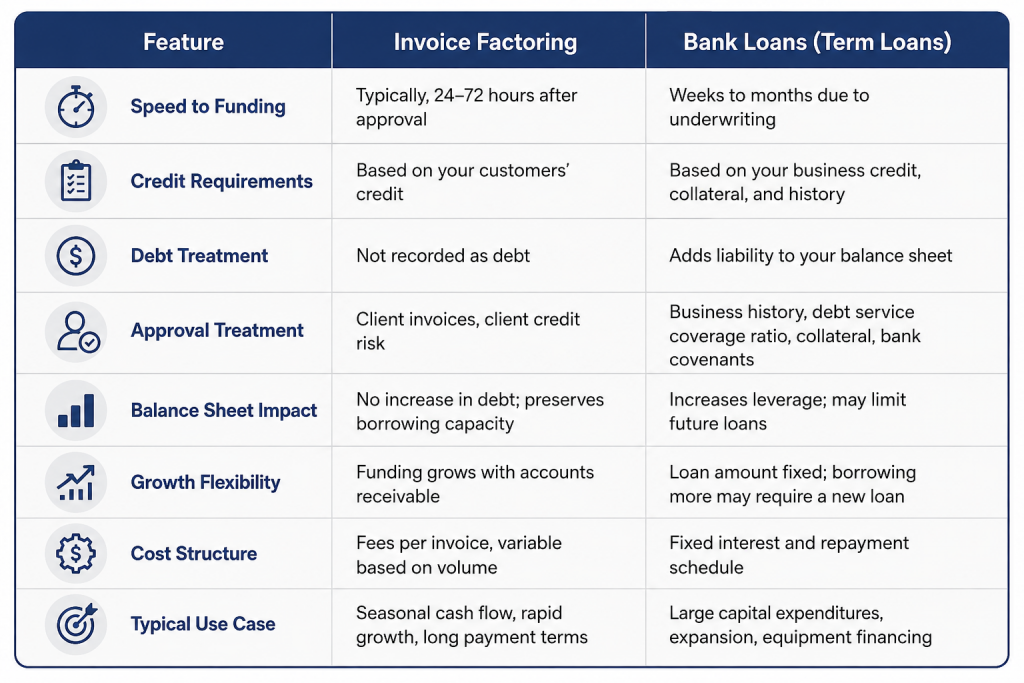
As the comparison shows, the core differences lie in structure. Bank loans provide fixed capital with fixed repayment, while invoice factoring provides variable funding tied directly to your receivables.
Example
A logistics provider has $100,000 tied up in outstanding customer invoices that are due in 30 days, but they need immediate cash to cover next week’s payroll.
Option A: The Bank Line of Credit
The Terms (Example Only): The bank offers an annual percentage rate (APR) of “8%”.
The Math: An 8% APR broken down monthly is roughly **0.67% per month**. On a $100,000 draw, you would owe approximately $670 in interest for those 30 days.
The Catch: While this looks incredibly cheap on paper, it misses the structural friction. To get this rate, the bank required three years of flawless financial statements, personal guarantees from the owners, blanket liens on all assets, and **60 days of underwriting**. If your payroll is due this Friday, this option is practically useless.
Option B: (Example Only) Invoice Factoring
The Terms: A factoring company charges a 2.5% factoring fee per 30 days and advances 95% upfront.
The Math:
1. Immediate Cash: The factor wires you $95,000 within 24 hours.
2. The Fee: The 2% fee on the total invoice value is $2,500.
3. The Rebate: When your customer pays the invoice on day 30, the factoring company releases the remaining 5% ($5,000) minus their $2,500 fee, netting you an additional $2500.
The Reality: On a strict APR basis, factoring is more expensive ($2,500 vs. $670). However, the business gained immediate access to capital without adding a liability to the balance sheet, without sacrificing asset liens, and based entirely on the solid credit score of their corporate client—not their own business history.
The Financial Takeaway
If you have months to spare and immaculate credit, a bank loan offers the lowest cost of capital. But if your growth is outpacing your bank account, factoring clears your cash bottleneck instantly—allowing you to take on larger contracts that would otherwise be out of reach.
Why Wait?
Start getting paid immediately
Loans vs. Factoring: Which Is Better for Your Business?
When choosing how to fund your business, you have to consider your circumstances and needs. The right small business finance strategy depends heavily on your business model, growth trajectory, and cash-flow needs:
- Invoice factoring is ideal for businesses with growing receivables, seasonal fluctuations, or long payment terms that need immediate cash to operate efficiently.
- Bank loans may work best for established businesses seeking a fixed, lump-sum loan for capital expenditures or planned investments.
Both business loans and factoring are viable funding methods. In many cases, businesses use a combination of both tools: loans for long-term investments and factoring to manage day-to-day operational cash flow and support stronger cash flow management.
Some businesses also consider a business line of credit as part of their funding strategy, though approval requirements and balance sheet impact are similar to traditional bank financing. If you’re evaluating additional strategies, see our guide on invoice factoring vs. other financing options for a broader comparison of common business financing solutions.
Your Best Choice for Invoice Factoring Is Riviera Finance
If you’re seeking factoring services for funding your business, Riviera Finance has half a century of experience serving clients in many industries. To find out more about how invoice factoring can help your business, schedule a free consultation with Riviera Finance.
Our Process

STEP 1
Apply
Complete form & become a Riviera client

STEP 2
Service
You deliver your products or services

STEP 3
Send
Send your invoices to Riviera Finance

STEP 4
Get Paid
Riviera verifies & pays you within 24 hours
Why Wait?
Start getting paid immediately
About The Author

Jacquelyn holds a degree in Business Administration and has over 17 years of experience in the commercial finance industry, including the past 7 years specializing in invoice factoring.