

Invoice factoring and asset-based lending (ABL) are often grouped under one receivables-based financing label. Both can improve cash flow, and both involve your receivables. Yet what looks like one category is really two separate models.
They operate very differently in terms of structure, risk allocation, and day-to-day operational impact. This guide offers a comparison between invoice factoring vs. asset-based lending (ABL), and which may be the right fit.
At a Glance: Invoice Factoring vs. Asset-Based Lending (ABL)
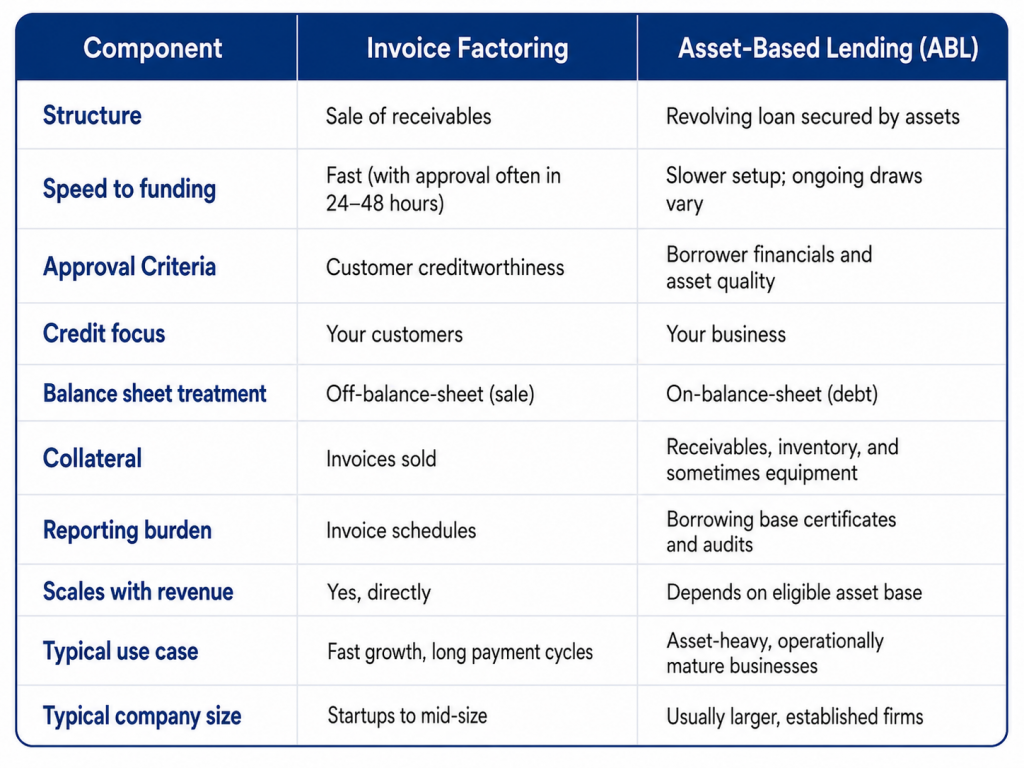
How Invoice Factoring Works
When a business factors invoices, it sells those receivables to a factoring company at a discount. The factoring company advances a percentage of the invoice value (up to 95%) and remits the remainder (minus fees) once the customer pays.
With invoice factoring:
- Invoices are sold, not pledged. The transaction is a purchase, not a loan.
- Funding is tied directly to invoices issued. As your receivables grow, your available funding grows with them.
- Credit underwriting focuses on your customers, not your business. The factoring company is primarily assessing whether your customers will pay.
- Collections may be handled by the factor, depending on the arrangement. This reduces internal administrative load for some businesses.
Because the receivable is sold, the credit risk associated with customer non-payment typically transfers to the factor (only in non-recourse arrangements).
How Asset-Based Lending (ABL) Works
ABL is a revolving credit facility secured by a company’s assets. It most commonly involves accounts receivable, but often inventory and equipment as well. The lender doesn’t buy the receivables. Instead, it lends against them.
With ABL:
- A borrowing base determines how much you can draw. Lenders calculate eligible receivables (and other assets) and allow you to borrow a percentage of that figure.
- You submit borrowing base certificates regularly to update the lender on your eligible asset pool.
- Periodic audits and field exams are standard. Lenders conduct these to verify the quality and accuracy of the collateral.
- The loan stays on your balance sheet. This affects leverage ratios, covenant compliance, and how lenders or investors read your specific financials.
Unlike factoring, there’s no automatic paydown when customers pay. The business manages structured repayment separately, with interest accruing on outstanding balances.
Why These Structural Differences Matter
The differences between invoice factoring vs. asset-based lending have real implications for how your business operates and grows.
1. Risk Lives in Different Places
In a non-recourse factoring arrangement, the factor assumes the credit risk on your customers. If a customer doesn’t pay, it becomes the factoring company’s concern.
In ABL, you retain that risk. A customer default reduces the value of your collateral, which shrinks your borrowing capacity. The risk never leaves your books.
2. The Reporting Burden Is Not Equivalent
Factoring requires invoice schedules and basic documentation. ABL introduces a compliance layer that factoring doesn’t: borrowing base certificates, covenant monitoring, and periodic lender audits.
For businesses with strong internal controls, this is more manageable. For those without, it’s an operational commitment that means a lot more than just increased paperwork.
3. Debt Is Debt
Because factoring is a sale of receivables, it can be removed entirely from your balance sheet. ABL is a loan that adds leverage.
That distinction definitely matters if you’re managing debt covenants, preparing for future financing, or being evaluated by investors or acquirers on your leverage ratios.
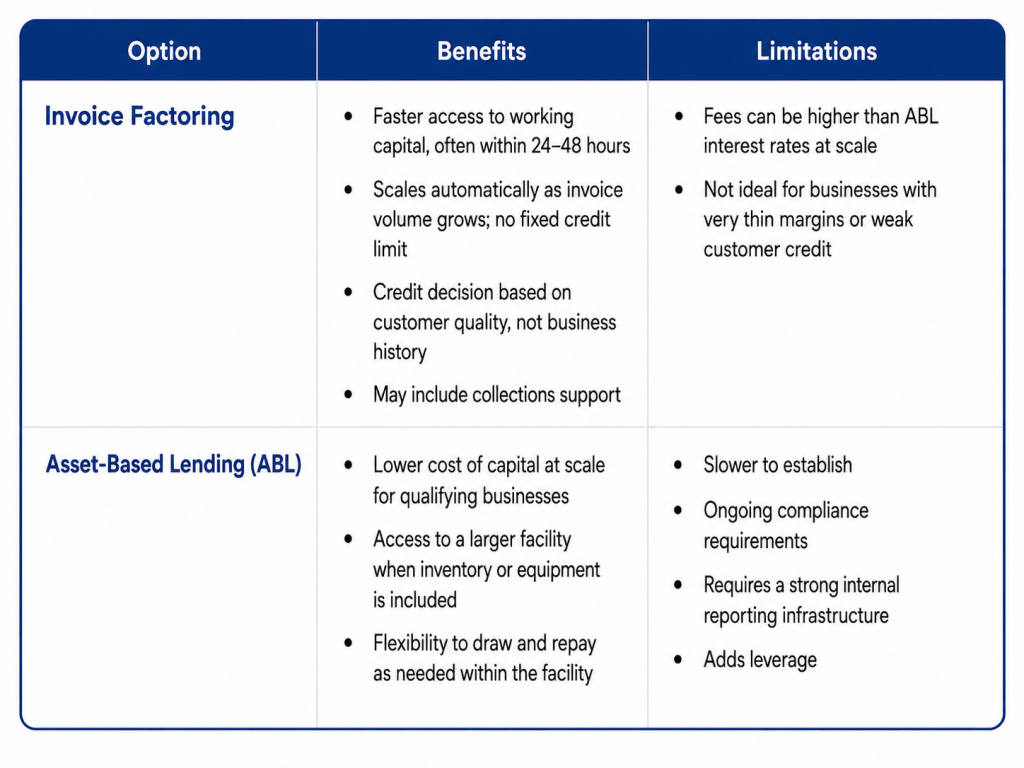
Typical Benefits and Limitations of Each
The table below captures the reality of invoice factoring vs. asset-based lending.
When Each Option Typically Makes Sense
Invoice factoring makes sense when a business needs speed, when funding requirements track directly to invoice volume, or when credit approval based on business financials would be a barrier.
Factoring tends to fit:
- Staffing, transportation, and service businesses with long payment cycles
- Fast-growing companies that need funding to scale before they have the financials to qualify for bank credit
- Businesses where customer creditworthiness is strong, but internal controls are still developing
ABL makes sense when a business has a diversified asset base, established financial controls, and the operational infrastructure to manage ongoing lender reporting. It’s also ideal when the lower cost of capital at scale justifies that overhead.
ABL tends to fit:
- Manufacturers and distributors with significant inventory alongside receivables
- Operationally mature businesses with established reporting systems
- Companies large enough to absorb compliance overhead and benefit from lower-cost revolving credit
Deciding Between Invoice Factoring and Asset-Based Lending
Factoring is a sale. ABL is a loan. They’re both legitimate tools, and the right fit depends on where your business is today and where it’s headed. If speed, flexibility, and off-balance-sheet financing align with your needs, factoring may be the more natural starting point.
For more than 55 years, Riviera Finance has helped small and mid-sized businesses across industries access working capital. Our team can help you evaluate whether factoring makes sense for your situation, with no obligation.
Put your receivables to work—contact Riviera Finance for a free consultation.
Our Process

STEP 1
Apply
Complete form & become a Riviera client

STEP 2
Service
You deliver your products or services

STEP 3
Send
Send your invoices to Riviera Finance

STEP 4
Get Paid
Riviera verifies & pays you within 24 hours
Why Wait?
Start getting paid immediately
About The Author

Dave Tremblay has more than 40 years of experience in logistics, operations, and financial process management, including leadership roles with Mattel and The Walt Disney Company. He has led multi-million-dollar projects and consulted for companies such as FedEx and Fiji Water, with expertise in efficiency methodologies like TQM and Kaizen. Dave currently serves as a Digital and Affiliate Marketing Manager and Logistics Category Expert at Riviera Finance, where he provides insight on supply chain operations, cash flow, and invoice factoring strategies.