

What’s the Difference Between Invoice Factoring vs. Invoice Discounting?
Invoice factoring and invoice discounting work differently in ways that matter, especially when it comes to who handles collections and how much operational responsibility stays with your business.
Both let you unlock cash from unpaid invoices, but exactly how they function determines which option is best for you. This guide compares invoice factoring vs. invoice discounting so you can have a clear-eyed view of each receivable-based financing structure.
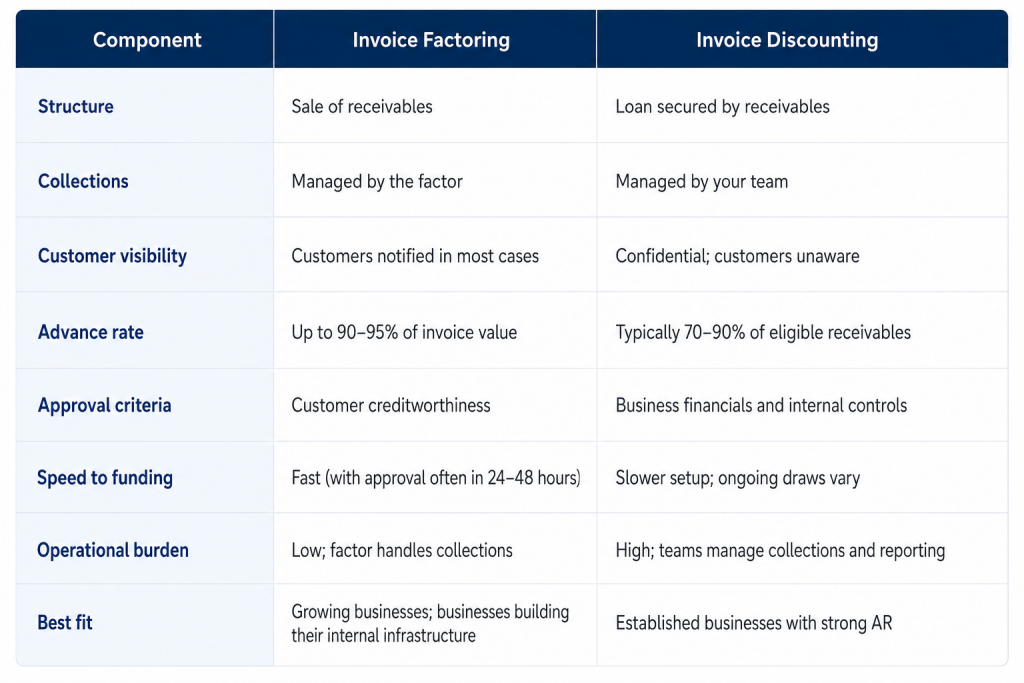
At a Glance: Invoice Factoring vs. Invoice Discounting
How Invoice Factoring Works
Invoice factoring is essentially a conversion—turning already-earned receivables into cash that can be used now rather than waiting for a customer’s payment terms to run out. Businesses sell an outstanding invoice to a factoring company, which then advances up to 95% of the invoice. They collect payment directly from the customer when it comes due, sending you the remaining balance, minus their fee.
A few things distinguish invoice factoring:
- It’s a sale, not a loan. The invoice transfers to the factor.
- Customers pay the factor directly. In most arrangements, customers are notified.
- Collections typically leave your plate. The factor handles follow-up and aging.
- Approval is driven primarily by customer credit quality and invoice quality. It is not the same underwriting used for a conventional loan.
In a non-recourse arrangement, the factor also absorbs credit risk. Recourse factoring, however, shifts the risk back to you.
How Invoice Discounting Works
With invoice discounting, instead of selling receivables, businesses borrow against them. A lender advances a percentage of the eligible invoice value (typically 70–90%). The business then repays that advance as customers pay their balance.
With invoice discounting:
- Your team handles collections. You’re not handing off any responsibilities or processes.
- It’s confidential. Generally customers are not aware of invoice discounting arrangements.
- It lives on your balance sheet. The advance impacts leverage.
- Approval is based on your business. Lenders evaluate your financials, not the customers’.
Ongoing reporting is also part of the picture. Most lenders require you to submit receivables information regularly, and some conduct periodic audits to verify collateral.
Why These Differences Matter in Practice
The invoice factoring vs. invoice discounting decision shapes how your business operates day to day.
1. Collections Responsibility
With factoring, collections usually become someone else’s job. This can be a real operational relief for businesses with lean teams or high invoice volume.
With discounting, collections stay with you. Your team still needs to follow up and handle any disputes. This isn’t usually an issue for teams with adequate bandwidth.
2. Customer Visibility
Some businesses are sensitive to their customers knowing they’re using financing.
Invoice discounting keeps that confidential. Factoring generally does not. For many businesses, this isn’t a major concern. In industries where client relationships are closely managed or where perception matters, it’s worth weighing.
3. Qualification
Factoring approval is primarily based on the customer’s creditworthiness. The arrangement is more accessible to businesses that haven’t yet built up years of financial history, like startups and growing businesses.
By contrast, invoice discounting requires lenders to feel confident in both your financials and your internal processes. Businesses earlier in their growth curve may find it less attainable.
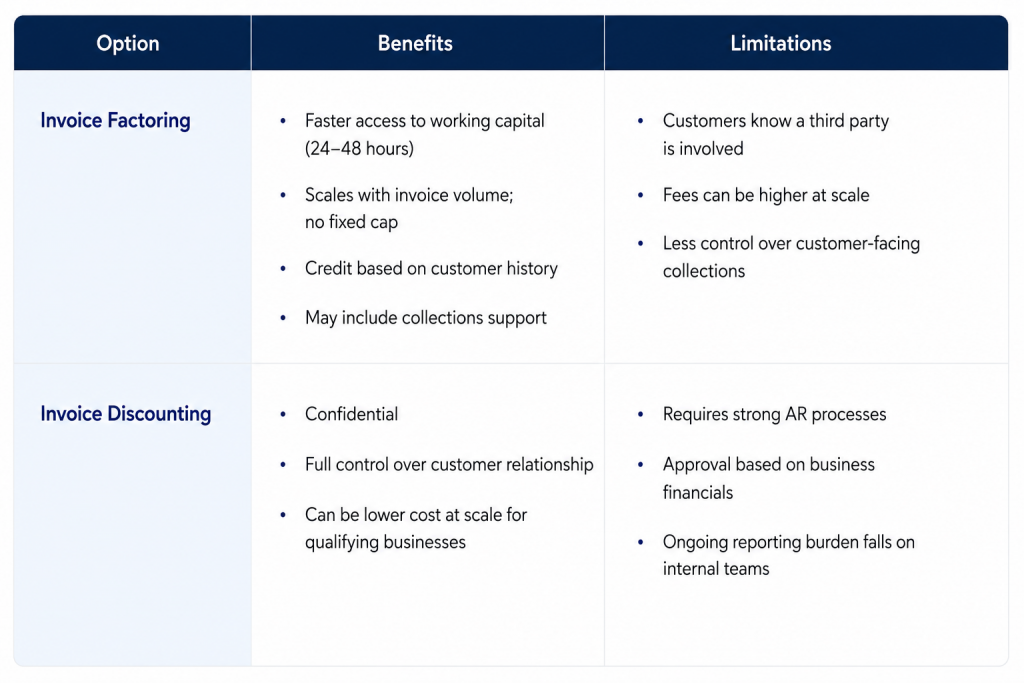
Common Benefits and Limitations of Each
Consider the advantages of invoice factoring vs. invoice discounting alongside their limitations.
Deciding When Each Option Makes Sense
Invoice factoring tends to be a better fit when:
- You need fast access to working capital
- You don’t have time for lengthy underwriting processes
- Your business is growing quickly
- Funding needs track closely to invoice volume
- Your internal team is lean
- Business history is limited
- Your customers have solid credit
It’s particularly ideal for staffing, transportation, construction, and other industries with long payment cycles.
Invoice discounting tends to be a better fit when:
- Confidentiality matters
- You have strong internal AR
- You want to maintain control over collections
- Your business has a solid financial track record
- You can prioritize a lower cost of capital at scale
If keeping financing off your balance sheet isn’t a priority, invoice discounting can be a solid choice.
Comparing Invoice Factoring and Invoice Discounting
Both invoice factoring and invoice discounting solve the same core problem: cash that’s tied up in invoices isn’t readily available to run your business. The difference is in the details, including whether your customers are in the loop and how your business is positioned right now.
For small and mid-sized businesses looking for speed and a solution that scales with revenue, factoring is often the more accessible starting point.
If you’re not sure which is right for your business, Riviera Finance can help. For over 55 years, Riviera Finance has helped businesses figure out the right path forward—and get funded fast when factoring is the best fit.
Talk to our team today—no obligation—and start making the most of your receivables.
Our Process

STEP 1
Apply
Complete form & become a Riviera client

STEP 2
Service
You deliver your products or services
STEP 3
Send
Send your invoices to Riviera Finance

STEP 4
Get Paid
Riviera verifies & pays you within 24 hours
Why Wait?
Start getting paid immediately
About The Author

Jacquelyn holds a degree in Business Administration and has over 17 years of experience in the commercial finance industry, including the past 7 years specializing in invoice factoring.